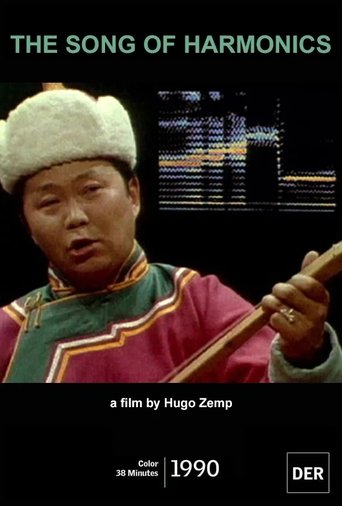
The Song of Harmonics (1990)
The Radar read
A quieter title still finding its audience, though the rating rests on a thin sample, so treat it as provisional.
Synopsis
In the practice of overtone singing (called also bi-phonic singing), whose best-known examples can be found in Mongolia and with the Tuva people of Southern Siberia, a single person sings what the audience perceives as two voices at the same time: a low pitch with his vocal cords, and in addition, a high-pitched melody using harmonics (overtones) selected by modifying the volume of the mouth cavity. This documentary is not an ethnography filmed in location. It is partly an illustration of the results of former research, partly the very actual investigation on overtone singing carried out in Paris, in the Ethnomusicology Department of the Musée de l'Homme, during a workshop, during a concert of the Mongolian National Ensemble, and in the medical visualization department of a hospital.
Synopsis and metadata sourced from The Movie Database (TMDB).
Movie DNA · Double Feature
What should you watch after The Song of Harmonics?
Compare atmosphere, emotion, pace, twists, humour, romance, scale and realism — then get one ideal second feature.
Open Double Feature RadarRadar blends quality, momentum and freshness into one “what to watch now” number — so a great older film can sit lower than a rising new release. The Quality signal above is the time-neutral rating, which is why an acclaimed classic keeps a high quality score even when its Radar number is lower. Radar outputs are editorial algorithmic recommendations, not objective facts, and may change as signals update. A Radar score is not the same as a TMDB, IMDb or critic rating. How scoring works (v3.0).
 This product uses the TMDB API but is not endorsed or certified by TMDB. Streaming availability data powered by JustWatch.