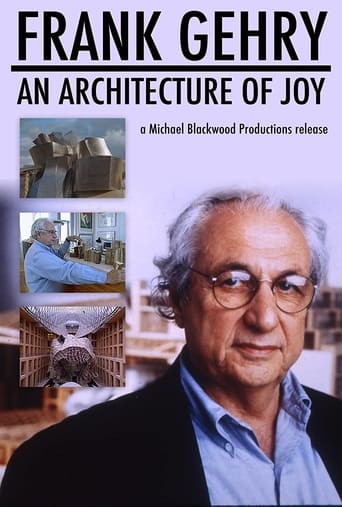
Frank Gehry: An Architecture of Joy (2000)
"Frank Gehry: An Architecture of Joy" illustrates the unique intertwining of art and architecture throughout Gehry's spectacularly eclectic career.
Werdykt Radaru
Cichszy tytuł, który wciąż szuka swojej widowni, choć ocena opiera się na wąskiej próbie, więc traktuj ją orientacyjnie.
Opis
"Frank Gehry: An Architecture of Joy" illustrates the unique intertwining of art and architecture throughout Gehry's spectacularly eclectic career. In this portrait, Gehry explores his work of the 1990's including The Guggenheim Museum in Bilbao and the Frederick R. Weisman Museum in Minneapolis, as well as his first European commission, the EMR Communication and Technology Center in Bad Oeynhausen, Germany. Seeing himself as an artist first, Gehry discusses his early relationships in the art world and how sculpture, painting and small scale work has influenced his architectural style. Like Rauschenberg, Johns, and Warhol, he has introduced "bad taste" into his concepts, while keeping himself outside of the contemporary dialogue between modernism and post-modernism. He has translated the vocabulary of contemporary art into an architectural language of his own, disobeying the rules of his profession and questioning its historic conventions.
Opis i metadane pochodzą z The Movie Database (TMDB).
Radar blends quality, momentum and freshness into one “what to watch now” number — so a great older film can sit lower than a rising new release. The Quality signal above is the time-neutral rating, which is why an acclaimed classic keeps a high quality score even when its Radar number is lower. Radar outputs are editorial algorithmic recommendations, not objective facts, and may change as signals update. A Radar score is not the same as a TMDB, IMDb or critic rating. How scoring works (v3.0).
 This product uses the TMDB API but is not endorsed or certified by TMDB. Dane o dostępności w streamingu dostarcza JustWatch.